Digital Safety Management on Construction Sites: The 2026 Guide
Transform your construction site safety with digital tools. Checklists, IoT wearables, AI detection, and Passeport de Prévention compliance strategies for modern site managers.
A single serious accident on a construction site costs an average of €35,000 in direct expenses—medical bills, equipment damage, regulatory fines. But that's just the visible part. Add indirect costs—project delays, investigation time, insurance premium increases, reputation damage—and the real figure climbs to €150,000 or more.
Here's the uncomfortable truth: 60% of accident investigations reveal incomplete or missing documentation. Paper safety checklists get wet, lost, or filled out after the fact. Toolbox talk sign-off sheets disappear. When an inspector asks for proof of training, the site scrambles.
The OPPBTP's 2026 campaign on pedestrian-vehicle separation is just the latest reminder that safety management needs to evolve. Digital tools aren't optional anymore—they're the foundation of defensible, effective safety programs.
Digital Safety Checklists: The Foundation
Paper checklists have a fundamental problem: they're easy to fake. A supervisor can check boxes at their desk without walking the site. Timestamps are whatever you write. Photos don't exist.
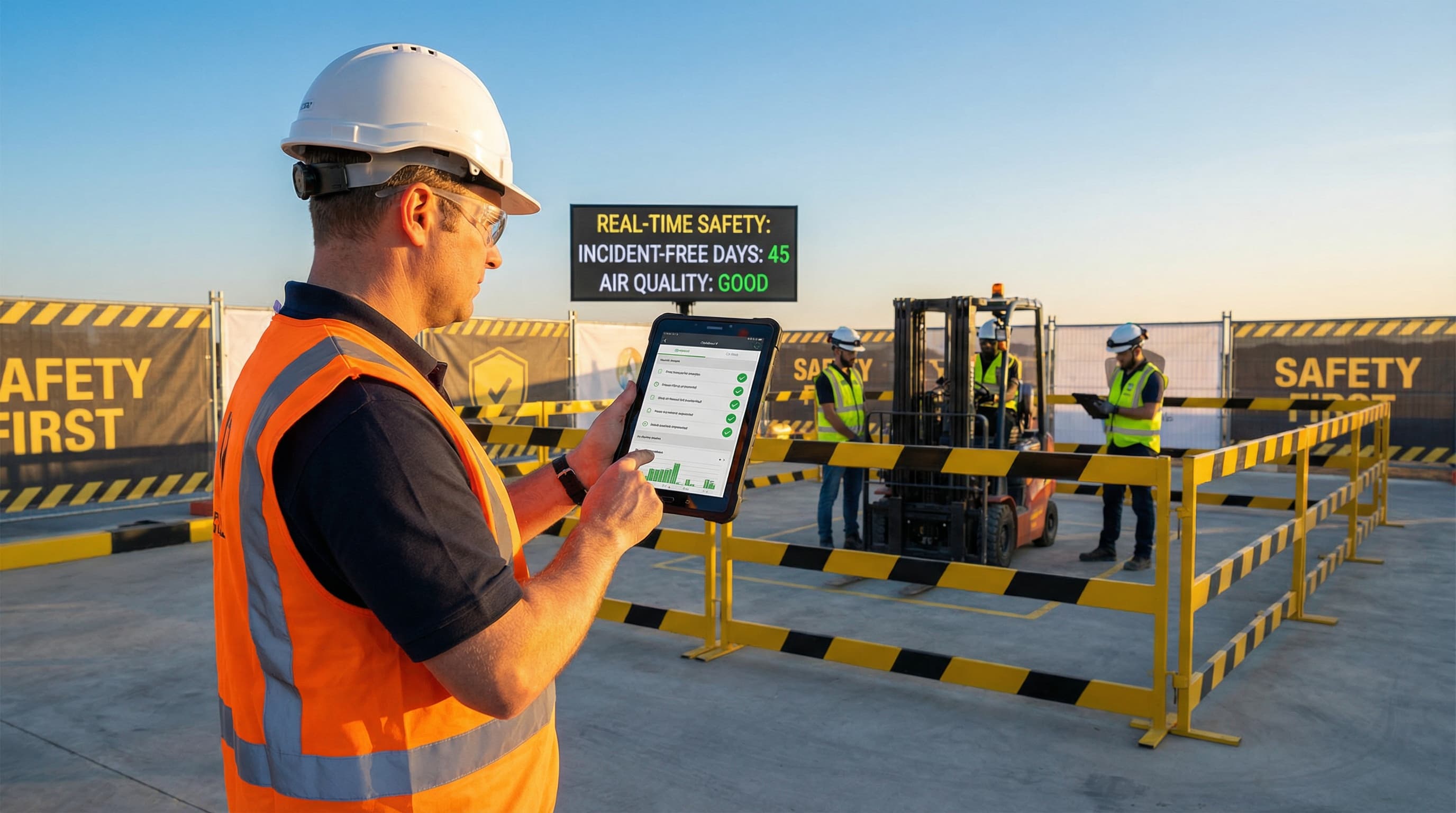
Digital checklists solve this by embedding verification into every entry:
What digital checklists capture:
- GPS coordinates—proving where the inspection occurred
- Timestamps—proving when it happened
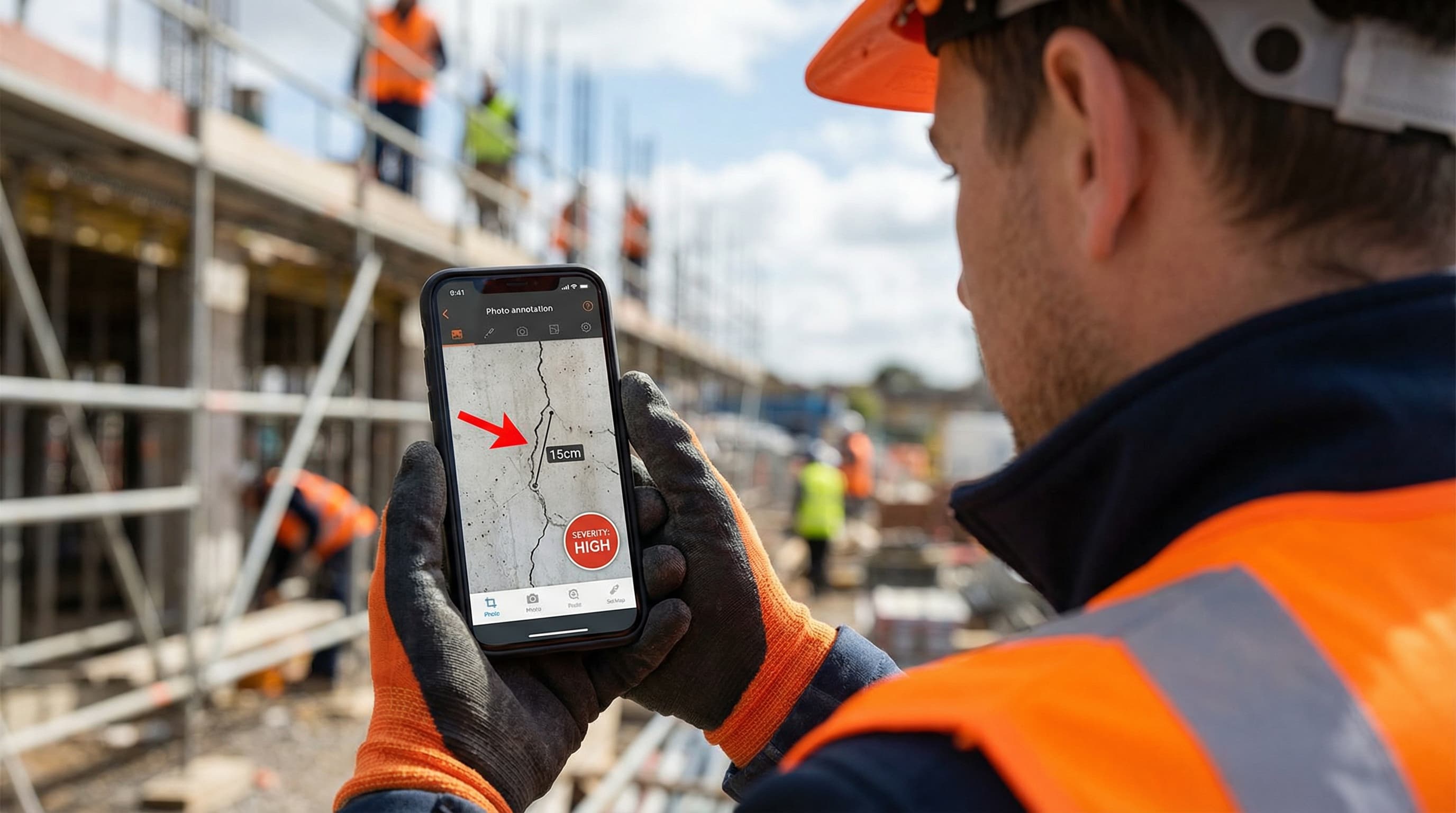
- Mandatory photos—visual evidence of conditions
- Signature capture—accountability trail
- Automatic escalation—critical findings trigger immediate notifications
The Three-Tier Inspection Rhythm
Daily pre-task checks (5 minutes): Before any work begins, the crew lead walks the immediate work area with their phone. Quick checks, mandatory photos of any hazards.
Weekly equipment inspections (20 minutes): Scaffolding, ladders, power tools, PPE condition. Deeper inspection with specific criteria per equipment type.
Monthly safety audits (2 hours): Comprehensive site review covering housekeeping, signage, emergency equipment, documentation status.
The 8-Item Daily Checklist
Print this or load it into your safety app:
- Work area clear of debris and trip hazards
- Required PPE present and in good condition
- Tools and equipment inspected for damage
- Exclusion zones properly marked
- First aid kit accessible and stocked
- Emergency exits unobstructed
- Weather conditions assessed for work type
- Photo documentation of current conditions
Toolbox Talks 2.0: Digital Causeries
The traditional toolbox talk—supervisor reading from a sheet while workers half-listen—is compliance theater. Digital tools transform these into actual safety interventions.
QR Code Sign-Off
Post a QR code at the meeting point. Workers scan with their phones to register attendance, see the day's topic, and confirm understanding. No more chasing signatures on clipboards.
Benefits:
- Instant attendance record with timestamps
- Workers receive the safety content on their device
- Easy proof of training for inspections
- Topics automatically logged to worker training records
Pre-Built Topic Libraries
Stop reinventing content. Modern safety platforms include libraries covering:
- Seasonal hazards (heat stress, cold, rain/mud)
- Task-specific risks (excavation, hot work, working at height)
- Equipment operation (crane signals, forklift safety)
- Emergency procedures (fire, injury, evacuation)
The 5-Minute Talk Structure
- Hook (30 seconds): Recent incident or near-miss—make it real
- Hazard identification (1 minute): What can hurt us today?
- Control measures (2 minutes): How we prevent it
- Worker input (1 minute): Questions, observations, concerns
- Confirmation (30 seconds): QR scan, verbal commitment
IoT and Wearables: Real-Time Protection
The next wave of safety technology puts sensors where the risks are—on workers and equipment.
Smart Helmets
Modern safety helmets can include:
- Impact sensors detecting falls or strikes
- Proximity alerts when entering danger zones
- Temperature monitoring for heat stress
- Communication systems for emergencies
Proximity Sensors
Vehicle-pedestrian collisions remain a leading cause of construction fatalities. Proximity systems:
- Alert operators when workers enter blind spots
- Warn workers approaching moving equipment
- Create automatic slow-zones near pedestrian areas
- Log near-miss data for safety analysis
Environmental Sensors
Fixed sensors around the site monitor:
- Air quality (dust, gases, VOCs)
- Noise levels requiring hearing protection
- Temperature and humidity for work-rest cycles
- Ground vibration near excavations
Real-Time Dashboards
All sensor data feeds into a central dashboard showing:
- Current worker locations
- Active alerts and their status
- Environmental conditions by zone
- Equipment operation status
The 5-Question IoT Readiness Assessment
Before investing in wearables and sensors, evaluate your site:
- Connectivity: Do you have reliable network coverage across the site?
- Charging infrastructure: Where will workers charge devices daily?
- Data management: Who reviews the data and takes action?
- Worker acceptance: Have you consulted the team on privacy and comfort?
- Integration: Does it connect with your existing safety systems?
AI for Risk Detection
Artificial intelligence is moving from novelty to practical safety tool. Current applications include:
PPE Detection
Camera systems with AI can identify:
- Workers without required hard hats, vests, or eyewear
- Incorrect PPE for the work zone
- PPE in poor condition (visible damage)
Alerts go to supervisors in real-time, creating a consistent enforcement mechanism that doesn't rely on human vigilance alone.
Behavior Analysis
More advanced systems detect:
- Workers in unauthorized areas
- Unsafe postures or movements
- Crowding in restricted zones
- Unusual patterns suggesting fatigue or distraction
RGPD Compliance Essentials
AI surveillance triggers data protection requirements:
- Transparency: Workers must know cameras exist and what they analyze
- Purpose limitation: Safety only—not performance monitoring
- Data minimization: Delete footage that isn't needed for incidents
- Access rights: Workers can request their recorded data
- Consult with your DPO before deployment
The 3-Tier AI Adoption Roadmap
Tier 1 (Now): PPE compliance cameras at site entry points
- Lowest privacy impact
- Clear, limited purpose
- Immediate safety benefit
Tier 2 (6 months): Zone monitoring in high-risk areas
- Excavations, crane operating zones, loading areas
- Expanded but focused coverage
- Worker input on implementation
Tier 3 (12+ months): Comprehensive behavior analytics
- Requires mature data governance
- Union/worker consultation essential
- Pilot before full deployment
VR/AR Safety Training
Traditional safety training—slides, videos, reading materials—achieves about 10% retention after one week. Virtual reality training shows retention rates of 75% or higher.
Why VR Works
- Experiential learning: Workers practice responses, not just watch them
- Safe failure: Mistakes in VR don't cause real injuries
- Emotional engagement: Immersive scenarios create lasting memory
- Repeatability: Train on rare scenarios without real risk
Current Applications
- Fall protection: Experience working at height, practice harness use
- Confined space: Simulate entry procedures and emergency response
- Equipment operation: Crane, forklift, and heavy equipment training
- Emergency response: Fire, injury, evacuation scenarios
ROI Framework
Calculate your VR training business case:
Costs:
- Hardware (headsets, controllers)
- Software licensing or development
- Trainer time for facilitation
- Maintenance and updates
Benefits:
- Reduced training time (typically 40-60% faster)
- Lower travel costs for specialized training
- Fewer real-world training incidents
- Improved retention reducing refresher frequency
Break-even typically occurs at 50-100 workers trained for off-the-shelf solutions.
Passeport de Prévention: France's 2026 Digital Registry
France is rolling out the Passeport de Prévention—a national digital registry tracking every worker's safety training. For construction site managers, this changes everything about training documentation.
What It Means
- Every safety training a worker completes gets registered nationally
- Workers can prove their qualifications with a single digital credential
- Employers can verify training status instantly
- No more filing cabinets full of certificates
Site Manager Implications
- Verification: Check worker qualifications before site access
- Gap identification: See what training team members need
- Compliance proof: Demonstrate to inspectors that all workers are qualified
- Simplified onboarding: Workers bring their training history with them
The 5-Step Preparation Checklist
- Inventory current training: Document all safety training your team has completed
- Register with the platform: Set up your company account when available
- Audit your training providers: Ensure they'll report to the Passeport system
- Update procedures: Modify onboarding to include Passeport verification
- Communicate with workers: Explain the system and how to access their passport
BIM and Safety Coordination (SPS)
Building Information Modeling isn't just for design and construction—it's becoming a safety planning tool.
Safety Overlays on 3D Models
Modern BIM can include:
- Hazardous zones highlighted by phase
- Exclusion areas around crane operations
- Pedestrian routes separated from vehicle paths
- Emergency access maintained throughout construction
- Temporary works locations and load limits
Digital PGC/PPSPS
The Plan Général de Coordination and Plans Particuliers become dynamic documents:
- Updated as construction progresses
- Accessible to all trades on any device
- Version-controlled with clear change history
- Linked to the 3D model for spatial clarity
When a subcontractor arrives, they can review their specific safety requirements on a tablet, seeing exactly where their work zone is and what adjacent hazards exist.
Implementation Path: Month-by-Month
Transforming site safety takes time. Here's a realistic roadmap:
Week 1: Digital Checklists
Replace one paper checklist with a digital version. Start with the daily pre-task check—it's short, frequent, and immediately shows benefits.
Success metric: 100% of daily checks completed digitally
Week 2: Digital Toolbox Talk Sign-Offs
Implement QR code attendance for causeries. Keep the talk format the same initially; just change how you record attendance.
Success metric: Complete attendance records with timestamps
Week 3: Photo Documentation
Add mandatory photos to your daily checks. Require at least 2 photos per check—one showing general conditions, one showing any specific finding.
Success metric: Photo evidence attached to every inspection
Week 4: Dashboard and Reporting
Connect your tools to create a weekly safety dashboard. Track completion rates, open findings, and resolution times.
Success metric: Weekly safety report generated automatically
Month 2+: IoT and AI Pilots
With fundamentals in place, pilot advanced technologies:
- Start with one high-risk zone for camera monitoring
- Trial proximity sensors on one equipment type
- Evaluate wearables with a volunteer group
Quick-Start Safety Checklist
Use this checklist to transform your safety management:
Before Each Shift
- Digital daily check completed with photos
- Toolbox talk topic selected and loaded
- Work permits verified in system
- Equipment inspection records current
- Weather alerts reviewed
During the Shift
- Toolbox talk delivered with QR attendance
- Observations logged immediately (not end of day)
- Photos taken of any findings or changes
- Near-misses reported through the app
- Worker concerns captured digitally
End of Shift
- Inspection findings resolved or escalated
- Equipment secured and condition logged
- Next-day hazards flagged in system
- Dashboard reviewed for trends
- Reports generated for site records
Digital safety management isn't about replacing human judgment—it's about giving supervisors better information, clearer records, and more time to focus on what matters. Start with one digital checklist this week. Build from there. The technology exists; the question is whether you'll use it before or after the next incident.